The Early Days of Girls' Tennis
By ROBERT PRUTER
When the IHSA chose to launch its sponsorship of interscholastic athletic competition for girls, in 1972, that first year only one state title was initially sponsored, and that was for tennis. Oak Park-River Forest High won the title in the 1972 IHSA state tennis championship, which represented the first state tournament conducted in any sport for girls in Illinois. It seemed appropriate that tennis would be chosen, as it was the earliest sport that engaged girls in Illinois high schools, at least intramurally.
From close to the beginnings of high school interscholastic activity, Illinois schoolgirls have been playing tennis. The sport (in the unenergetic way it was played then) was considered an acceptable form of competition for girls, but development of interscholastic competition was slow. As early as 1891, girls were competing in tennis on an intramural level, notably in West Division High School, but not until the school year of 1909-1910 did local schools form girls' tennis teams for purpose of interscholastic competition. Waller (which also went by its old name North Division) seemed to be a pioneer in girls' tennis, forming a team in 1910 and getting a contest up with Northwest Division. By the following year, interest in the sport had so swelled that the Cook County League conducted its first girls' league schedule with eight schools.
Following the breakup of the Cook County League in 1913, the new Chicago High School League continued to offer girls' competition, at first in the spring of 1914, but then switching to the fall season in 1915. Hyde Park, Lake View, Waller, Marshall, and Englewood were some of the schools that entered girls' teams in competition. Hyde Park, a hotbed of high school tennis at the time, dominated competition.
The tennis series in these years generated one star, Marian Leighton, who was subject of a feature article in the Chicago Tribune in 1916. She headed the Girls' Athletic Association at Hyde Park High and participated in basketball and swimming, as well as tennis. In 1915 and 1917 she won the league's singles tennis title. What made her outstanding was that she introduced a more athletic approach to girls' tennis. Said the Tribune, "Miss Leighton plays a strenuous brand of tennis, has a stiff service and stinging return." Leighton during the 1920s became a highly successful competitor on the amateur tennis circuit, winning the Western title, several state titles, and the Chicago city title for five consecutive years. Hyde Park was in the forefront of girls' tennis during these years, and the school dominated most of the competitions. Other Chicago schools competing in the final conference meet were Bowen, Tuley, Marshall, Waller, and Lake View.
The Chicago High School League did not sustain its support in girls' tennis, choosing to make the October 1917 tournament its last. The Chicago public schools were not members of the Illinois High School Athletic Association (IHSAA, now IHSA), but the schools often took their cue on policies on regulating interscholastic sports activity. At that time the IHSAA was enforcing a complete ban on interschool contests by girls. The Chicago High School League, however, would revisit tennis for girls in the 1920s.
Meanwhile, Chicago high school girls, however, found opportunities for outside competition in the burgeoning junior tennis movement. In girls junior competition, girls had to be 17 years and under. Occasionally, the newspapers might make reference to the high schools of the junior competitors
The Chicago Public High School League decided to revive tennis for girls in 1922, and it took off more strongly than did golf, another sport that the league offered to girls that year. The league championship was usually held in late June, but there were two months of dual-meet competition preceding the city championship series. The championship was determined by dual meet playoffs between schools represented by two singles competitors and one doubles team. Some schools fielding tennis teams included Senn, Lindblom, Parker, Schurz, Lake View, Hyde Park, and the all-girls school, Lucy Flower Vocational. While the tennis competition was not reported on in 1922, the following year Senn won the team championship, besting Lindblom in the finals 2-1, taking one singles and one doubles match. In 1924, Parker beat Senn for the city championship.
In 1925, there were enough teams to hold regular season competition in three sections, West, North, and South. Schurz High won the title by defeating Hyde Park, 3-0. By 1926, the program had grown to include 13 schools organized into four sections-Central, West, North, and South. Tennis had clearly taken off, as Lindblom won the league title, besting Marshall 3-0, having gone through the season undefeated.
The tennis competition of 1926 was the last conducted by the Chicago schools. Its end was a by-product of other changes in interscholastic sports that year. In 1926, the IHSAA assumed sponsorship with the University of Illinois of its annual track and field, tennis, and golf tournaments. Chicago schools, which up to that time were not members of the IHSAA, were now forced to join the organization if they wanted to still continue to participate in those spring contests. In March 1926, Lake View, Schurz, Hyde Park, Tilden, Lindblom, and Englewood joined the IHSAA, and soon many other Chicago public schools followed. Among these schools were some of the biggest supporters of girls' competition. The schools at one point asked to become members while still retaining the Chicago Public High School League's rules and by-laws. The IHSAA, however, insisted that Chicago schools could only belong if they abided by the IHSAA rules and by-laws alone.
Ominously for the Chicago high school girls, the IHSAA by-laws in 1926 barred all interscholastic competition in all girls' athletics. If the Chicago schools wanted to participate in the state basketball tournament, which was growing ever more popular, and wished to continue their track and field participation, their own rules, including the rules that allowed girls' interschool competition, would have to be sacrificed. Thus, Chicago school authorities ended all high school interscholastic competition for girls, official and unofficial, by the beginning of the 1926-27 school year.
Ironically, after the Chicago schools abolished its golf and tennis tournaments for girls, the IHSAA amended its by-laws in 1927 to end the ban on interschool golf and tennis contests. The Chicago schools did not choose to readopt such competition, however. The Chicago Public League would eventually reintroduce tennis for girls in the early 1970s, when the sport reemerged under Illinois High School Association encouragement. None of those schools would recall the earlier time in the 1920s when interscholastic girls tennis prospered.
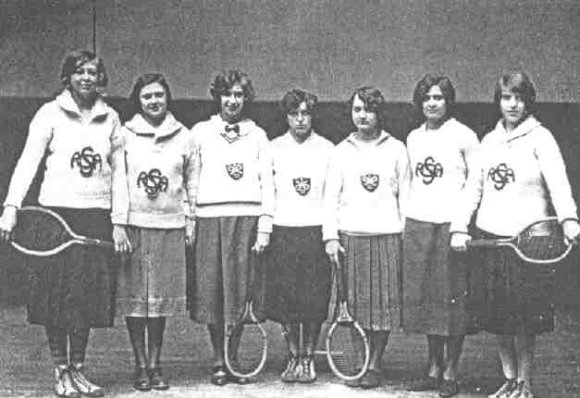
Senn Girls' Tennis Team, 1926. From the school yearbook.
Posted April 1, 2005.
Footnotes available upon request. Published with permission. All rights are reserved by the author.
The opinions expressed in this article are those of the author and not necessarily those of the Illinois High School Association.